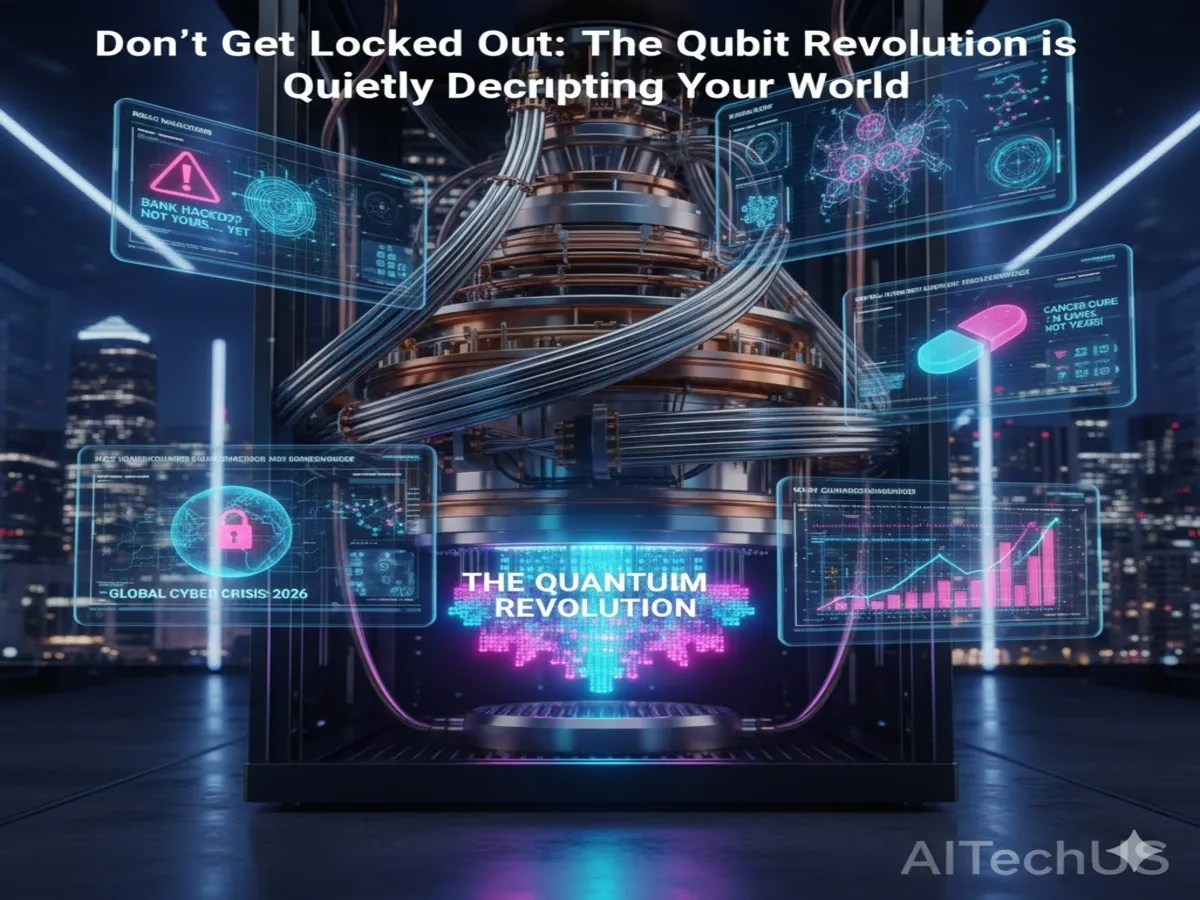
As of January 2026, the tech world is no longer just talking about “future” quantum computers. In laboratories from Silicon Valley to Boston, a massive shift has occurred: we have moved from the era of “noisy” experimental qubits to Logical Qubit stability. If you think quantum computing is just a faster version of your PC, you are missing the most critical pivot in modern history. This is not an upgrade; it is a complete rewrite of the laws of reality.
1. Beyond the Bit: The “Qubit” Explained
In a traditional computer, every bit is either a 0 or a 1—like a light switch that is either on or off. But a Qubit (Quantum Bit) uses the principle of Superposition.
Imagine a coin spinning on a table. While it’s spinning, it is both heads and tails at the same time. This allows a quantum computer to explore millions of possibilities simultaneously. In 2026, the breakthrough keyword is Real-Time Rendering of Quantum States, where scientists can finally visualize and correct these fragile states before they collapse.
2. The FOMO Factor: Why You Can’t Ignore 2026
Why should the average American care right now? Because Quantum Advantage has arrived in specialized fields.
- Medicine: US-based startups are using qubits to simulate molecular interactions in real-time, cutting drug discovery times from years to days.
- Security: This is the urgent part. Our current “unbreakable” encryption (like the kind protecting your bank) is theoretically child’s play for a 1,000-qubit processor.
- Energy: Companies are using quantum algorithms to optimize the US power grid, potentially saving billions in energy waste.
If you aren’t watching the shift toward Quantum-Safe Encryption, your digital identity could be at risk before the decade is out.
3. The 2026 Hardware Race: Trapped Ions & Superconductors
The USA is currently the battlefield for two major technologies:
- Superconducting Qubits (IBM/Google): These need temperatures colder than outer space to function.
- Trapped Ion Qubits (IonQ/Quantinuum): These use individual atoms suspended in a vacuum. In 2026, Trapped Ion tech is trending because it can operate with higher “fidelity” (fewer mistakes), making it a more trustable tool for American enterprises.
Frequently Asked Questions (FAQs)
Q1: Will I have a quantum computer on my desk?
No. In 2026, quantum power is delivered via the cloud. You’ll use your regular MacBook or PC to access “Quantum-as-a-Service” (QaaS) from providers like AWS or Microsoft Azure.
Q2: Can qubits really “break the internet”?
They can break current encryption. That is why the US government is urgently pushing for Post-Quantum Cryptography (PQC) standards this year.
Q3: Is a qubit just a faster bit?
Not exactly. For simple tasks like browsing or word processing, your current bit-based PC is better. Qubits are only faster for “needle-in-a-haystack” problems like complex logistics, chemistry, and massive data optimization.
Sources & Authenticity Credits
- NIST (National Institute of Standards and Technology): For 2026 Post-Quantum Cryptography standards.
- ScienceDaily & Nature: For January 2026 breakthroughs in “Logical Qubit” error correction.
- IBM Quantum Roadmap: For real-time updates on the 1,000+ qubit Nighthawk processor.
- The Quantum Insider: For 2026 industry trends and market valuation reports.