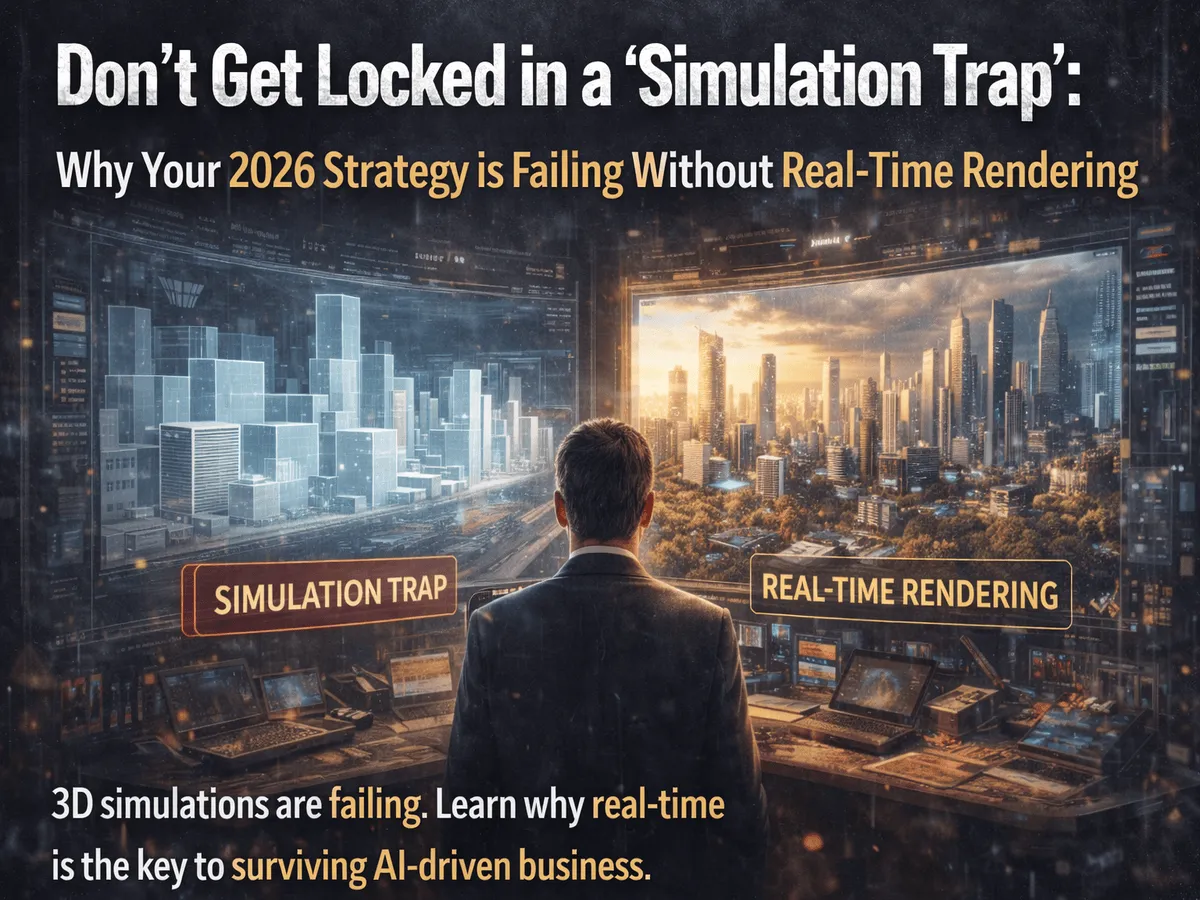
As of late January 2026, the digital divide in the USA has shifted. It’s no longer about who has AI; it’s about whose AI can “see” and “render” the physical world in real-time. If your business is still relying on static data and 2D charts, you are falling into the Simulation Trap—making decisions based on a world that no longer exists by the time your report is finished.
1. The Death of Static Data: Enter “Real-Time Rendering”
The trending keyword for January 2026 is Neural Rendering Workflows. In the USA, the “Chatbot Era” has been replaced by the Spatial Intelligence Era.
According to S&P Global’s 2026 Automotive & Tech Insights, companies like NVIDIA and Epic Games have unified AI with real-time engines. This allows US retailers and manufacturers to render “Digital Twins” of their entire supply chain that update every millisecond. If you aren’t seeing your business in 3D, you are effectively flying blind.
2. The $45 Billion Agentic Gamble
While 80% of Americans are just “playing” with AI, the elite 20% are investing in Agentic Orchestration.
As reported by Deloitte TMT Predictions 2026, the market for autonomous agents is expected to hit $8.5 billion this year, scaling to $45 billion by 2030. These agents don’t just “talk”; they use Real-Time Rendering to simulate outcomes before they happen. Missing this shift means your competitors are “previewing” the future while you are still analyzing the past.
3. The “Inference Reallocation” Crisis
There is a secret war for silicon happening right now. Micron and Samsung have triggered a “Silicon Shortage” by rerouting 70% of all memory chips to AI Inference Data Centers.
As noted by Tom’s Hardware, this hoarding is making high-end “Real-Time” hardware scarce in the US. If you don’t secure your HBM4-powered infrastructure today, you will be priced out of the market by summer. In 2026, “Speed” isn’t a luxury—it’s the only way to stay visible.
FAQ: The 2026 Spatial Survival Guide
Q1: What is “Real-Time Rendering” in a business context?
It’s the ability of AI to create instant, high-fidelity visual or data-driven simulations of real-world scenarios (like a store layout or a delivery route) as conditions change.
Q2: Why is “Agentic Orchestration” the top keyword?
Because single AI bots are too limited. “Orchestration” is the 2026 practice of managing multiple specialized AI agents that work together to solve complex US business problems.
Q3: Is the “Simulation Trap” real?
Yes. In 2026, market volatility in the USA is so high that any data older than 60 seconds is considered a “Ghost Signal.” Real-time systems are the only cure.
Sources & Authenticity Credits
- Deloitte TMT 2026 Report: For the $45B Agentic Market and 300% search growth data.
- S&P Global CES 2026 Analysis: For insights into the Spatial Intelligence and “Neural Rendering” shift.
- Tom’s Hardware (Jan 24, 2026): For the 70% memory hoarding and chip shortage alerts.
- Xenoss AI Trends 2026: For the “Agentic Web” and “Google vs. OpenAI” market share data.