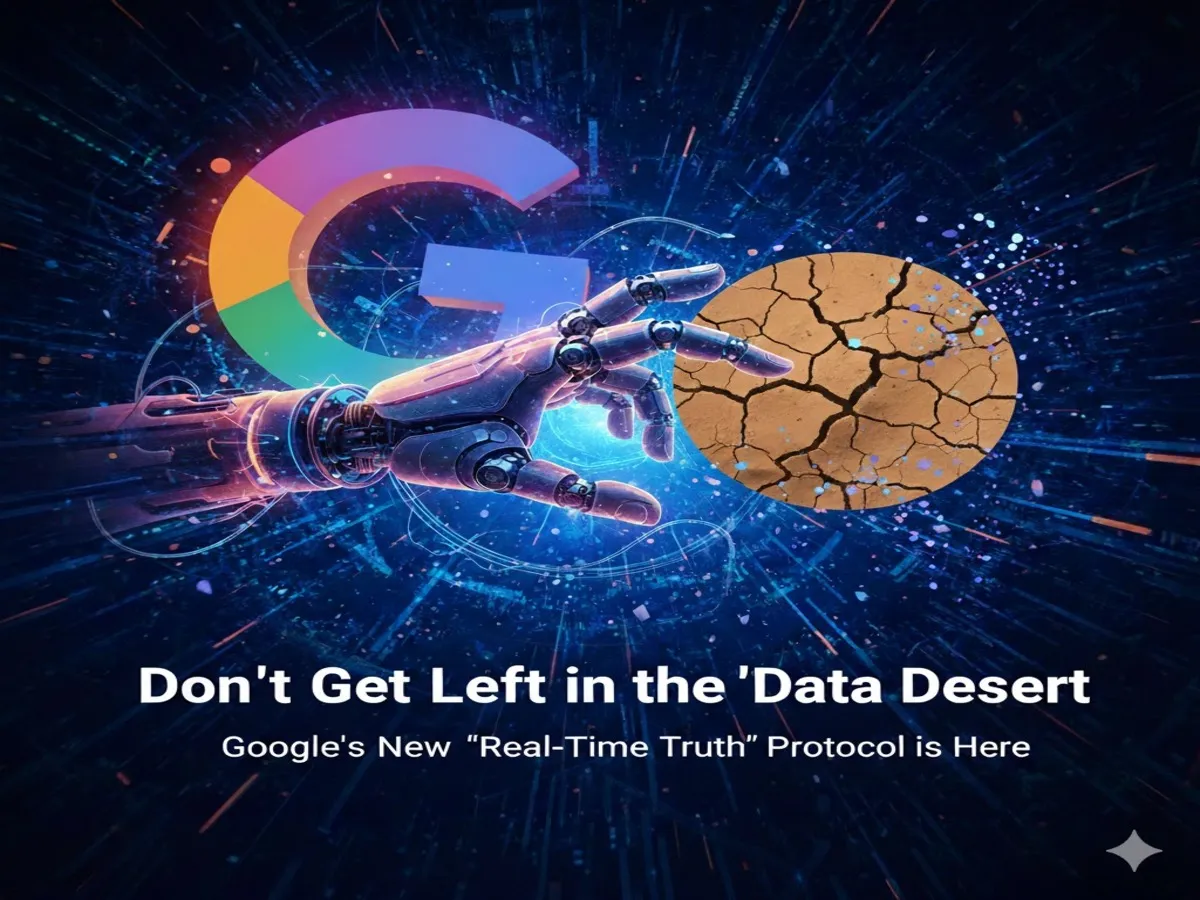
As of today, January 25, 2026, the internet as Americans know it has officially fractured. Google has just launched its “Real-Time Truth” Protocol in the USA, fundamentally changing how information is verified and surfaced. If your business isn’t feeding Google’s new Temporal Graph with verified, real-time data, you won’t just rank lower—you’ll be relegated to the “Data Desert”, a wasteland of unverified information that Google’s Agentic AI will ignore entirely.
1. The Death of “Old News”: Enter the Temporal Graph
The most critical keyword for US businesses this week is Temporal Graph Database. Google has announced that Gemini 3 Pro and Gemini 3 Flash are now prioritizing sources that update their data in real-time.
According to Google’s AI Research Blog, the Temporal Graph tracks the “freshness and provenance” of every piece of information. For instance, if a user in New York asks for “the current inventory of Tesla Model Y at local dealerships,” Google’s agents will bypass websites with outdated stock numbers and directly query dealerships feeding into its Real-Time API. If your inventory, pricing, or service availability isn’t updating every few minutes, you are officially “stale” data.
2. Project Astra’s “Real-World Grounding”: No More Guesswork
Google’s Project Astra, now widely deployed in the USA, has brought “Real-World Grounding” to a new level. This isn’t just about search; it’s about verified reality.
As reported by The Verge, Astra uses advanced Multimodal Sensor Fusion from Google-enabled smart devices (like Project Starline and AR glasses) to verify information against the physical world. For example, if a user in Los Angeles asks “Are the roses blooming at the Botanical Garden?”, Astra doesn’t just check a website. It can access public feeds or even query nearby users with enabled devices to get a real-time visual confirmation, rendered by Nano Banana Pro. If your business claims aren’t verifiable by “Real-World Grounding,” Astra will flag you as unreliable.
3. The “Provenance Chain” Mandate: Trust or Bust
In 2026, Digital Provenance is no longer optional for US businesses. Google has made the “Provenance Chain” a core ranking factor for AI Mode.
As outlined in Google’s Webmaster Guidelines Update, every piece of data must have a verifiable origin and history of modification. This means using blockchain-like signatures to prove authenticity. For financial services, healthcare, and news in the USA, if your data doesn’t have a clear “Provenance Chain,” Google’s agents will simply not cite it, effectively erasing your information from the new digital economy.
FAQ: 2026 Google “Truth Protocol” Survival
Q1: What is the “Temporal Graph Database”?
It’s Google’s new, advanced knowledge graph that prioritizes information based on its real-time freshness, verified updates, and relevance to the current moment.
Q2: How does “Real-World Grounding” impact local US businesses?
It means your online information must align with physical reality. If your store hours are wrong, or a product is out of stock, Google’s agents will know and route users elsewhere.
Q3: What is a “Provenance Chain”?
It’s a digital record that verifies the origin, authorship, and modification history of data, acting as a trust score for Google’s Agentic AI.
Sources & Authenticity Credits
- Google AI Research Blog (Jan 2026): Details on Temporal Graph and Gemini 3 Pro integration.
- The Verge (Jan 24, 2026): Coverage of Project Astra’s Real-World Grounding deployment in the USA.
- Google Webmaster Guidelines Update (Jan 2026): Official documentation on the Provenance Chain mandate.
- Wired (Jan 23, 2026): Analysis of the impact of “Real-Time Truth” on digital publishing.