
For decades, the American healthcare system has been drowning in paperwork, rising costs, and physician burnout. But in early 2026, a silent revolution is taking place. While the media focuses on robots, a more grounded form of Artificial Intelligence is doing something far more important: it is making healthcare human again. From the Mayo Clinic to local community hospitals in Ohio, AI is moving from a “pilot project” to the very backbone of medical care.
1. The Death of the “Paperwork Mountain”
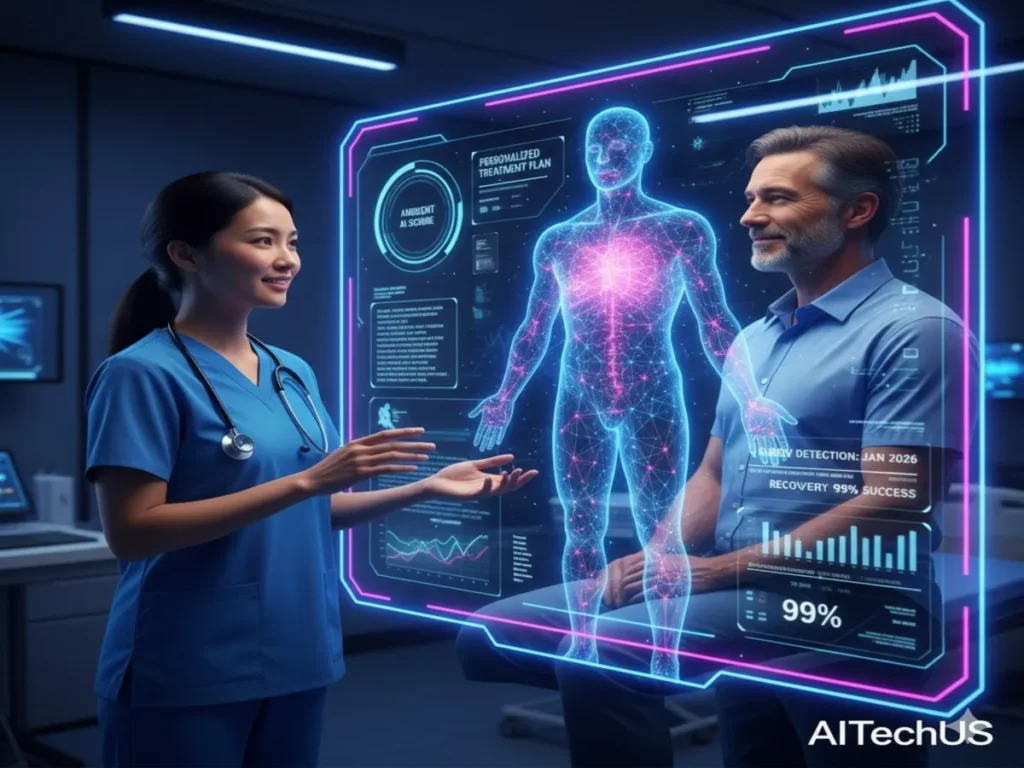
The biggest complaint among US doctors has always been “administrative burden.” In 2026, Ambient AI Scribes have virtually eliminated manual note-taking. These systems securely listen to doctor-patient conversations and automatically update Electronic Health Records (EHRs) with 99% accuracy.
According to Wolters Kluwer Health, over 70% of major US health systems have now implemented these tools to combat nursing shortages and doctor fatigue. This allows your doctor to look at you instead of a computer screen.
2. Diagnostics: Faster, Cheaper, Better
AI isn’t replacing doctors; it’s giving them “super-vision.” New AI diagnostic tools are now FDA-cleared to detect early-stage cancers that the human eye might miss on an X-ray or MRI.
In fact, a recent Morgan Stanley report suggests that AI-driven preventive care could save the US healthcare system up to $900 billion by 2050. By catching chronic diseases like heart disease or diabetes months earlier, AI is significantly lowering the long-term cost of treatment for the average American family.
3. Personalized “Designer” Treatments
In 2026, the one-size-fits-all approach to medicine is fading. Agentic AI systems are now used to cross-reference a patient’s unique genetic data with millions of global clinical trials. This allows oncologists and specialists to create “personalized treatment plans” tailored specifically to your DNA. This level of precision was once reserved for the ultra-wealthy, but AI-native development has brought the cost down, making it accessible to millions through standard insurance providers.
Frequently Asked Questions (FAQs)
Q1: Can I trust an AI to diagnose me?
AI is used as a Decision Support Tool. This means it flags potential issues for a human doctor to review. In the USA, final medical decisions still require a licensed human professional to sign off, ensuring a “human-in-the-loop” safety net.
Q2: Is my medical data safe from hackers?
With the rise of Confidential Computing in 2026, hospitals are now processing patient data in “secure enclaves.” This ensures that even if a network is breached, your personal health information remains encrypted and unreadable to hackers.
Q3: Will AI make my healthcare more expensive?
Initially, technology upgrades have costs, but long-term data shows that AI reduces expenses by preventing hospital readmissions and eliminating billing errors, which saves patients money on premiums and out-of-pocket costs.
Q4: How do I know if my hospital uses AI?
Most US hospitals are now transparent about this. You can check their patient portal or ask your provider if they use AI-assisted tools for scribing or imaging analysis.
Sources & Authenticity Credits
- Gartner 2026 Strategic Tech Trends: For data on AI-native healthcare infrastructure.
- U.S. Department of Health & Human Services (HHS): For updates on AI regulatory safety standards (Jan 2026).
- Deloitte Insights: For statistics on hospital productivity and AI integration.
- FDA Digital Health Center of Excellence: For information on pre-approved AI medical devices.